
LUCI and TALQ Join Forces to Advance Sustainable, Interoperable Urban Lighting
The TALQ Consortium, a global standardization body enabling interoperability in smart cities, and the LUCI Association, the international network of cities on urban lighting, announced their collaboration to support cities on their path towards more sustainable and interoperable street lighting. From July 2026, the TALQ Consortium has become an Associated Member of LUCI, while LUCI has joined the TALQ Partner Program. This two‑way collaboration brings together LUCI’s global community of cities and stakeholders with TALQ’s technical expertise gained by developing the open, vendor‑independent Smart City Protocol for managing interactive outdoor lighting and other smart city applications.
Today, cities face mounting pressures that directly impact how they plan, operate and justify investments in urban lighting and connected outdoor infrastructure. Tightening budgets and rising energy costs require measurable efficiency gains. At the same time, cities are expected to improve public safety, reduce light pollution, increase climate resilience, and ensure that public spaces are inclusive and well-served. These ambitions often collide with complex legacy infrastructure, fast-evolving technology choices, and procurement risks – especially the risk of locking into proprietary systems that limit flexibility over the lifetime of an installation.
Against this backdrop, the collaboration between LUCI and TALQ brings cities a practical bridge between urban lighting strategy and technical interoperability. With TALQ as an Associated Member of LUCI and LUCI joining the TALQ Partner Program, cities benefit from a closer alignment between these two experienced organisations, both of which have been active in the smart city environment for a long time.
Benefits for cities from this collaboration
Thanks to the shared knowledge and future joint city-focused events and publications, cities will be able to reduce investment and deployment risks through clearer guidance on interoperable architectures and specifications, supporting competitive purchasing and long-term flexibility.
Furthermore cities can initiate a faster, more scalable modernization of smart outdoor lighting by leveraging TALQ’s open interface approach while learning from LUCI cities’ real-world experiences. Overall they can expect to achieve measurable operational outcomes (energy performance, maintenance efficiency, service quality) by pairing city-led strategy discussions with standard-based implementation pathways.
Together, LUCI and TALQ aim to equip cities with both the strategic insight and the technical knowledge needed to develop sustainable, adaptable and future-ready urban lighting.
“I’m delighted to make our collaboration with LUCI public, as right from the beginning it felt like a perfect match and all discussions were extremely constructive. The smart city world can expect to see the first joint formats in the autumn of this year,” says Simon Dunkley, Secretary General of the TALQ Consortium.
“We are very pleased to welcome TALQ as an associated member of LUCI. Bringing together cities and key actors of the urban lighting ecosystem is at the heart of our mission, and this collaboration reflects our shared ambition to shape more sustainable and forward-looking lighting for cities at night,” adds Jasmine van der Pol, General Director of LUCI.
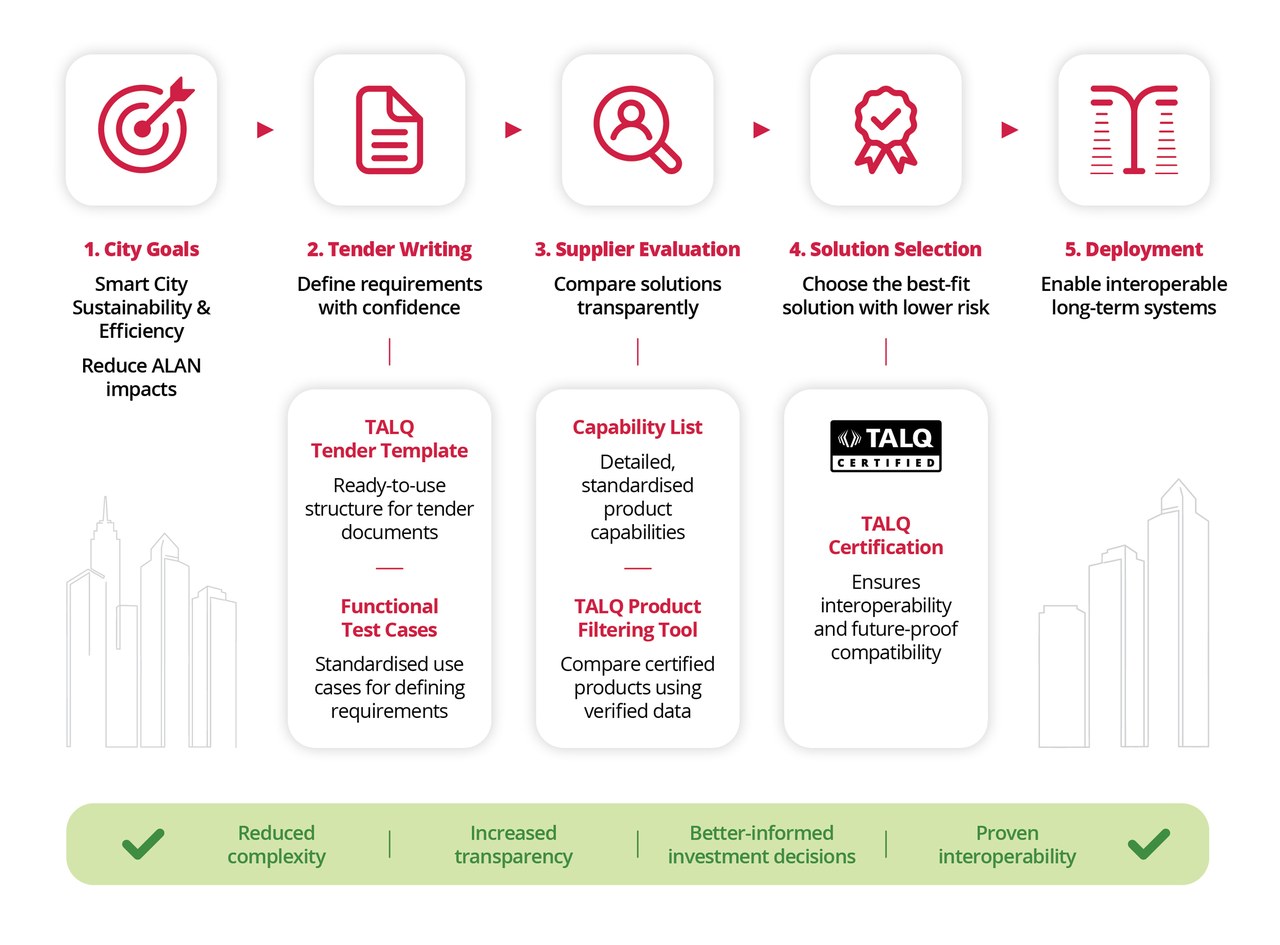
TALQ tools to enable sustainable street lighting and reduce adverse ALAN effects.
About the TALQ Consortium: Founded in 2012, the TALQ Consortium has established a globally accepted standard for management software interfaces to control and monitor heterogeneous smart city applications. The TALQ Smart City Protocol is a specification for information exchange, suitable for implementation in various products and systems. This way interoperability between Central Management Software (CMS) and Outdoor Device Networks (ODN) from different vendors is enabled.
Thanks to the TALQ protocol standard cities and municipalities can rely on a broad choice of interoperable systems and avoid vendor-lock-in when investing in smart city applications, such as Smart Street Lighting, Waste Management, Environmental Sensing, Parking, or Traffic Control.
TALQ is an open industry consortium currently consisting of more than 80 member companies. For more information visit www.talq-consortium.org
About LUCI Association: LUCI (Lighting Urban Community International) is the international network of cities on urban lighting. Created in 2002 and based in Lyon, France, LUCI brings together cities and associated members worldwide that use light as a tool for social, cultural, environmental and economic development, and promotes sustainable urban lighting policies and practices. More information: www.luciassociation.org
© 2026 Luger Research e.U. – Institute for Innovation & Technology
