Automotive LED Light Testing: From Design Trends to Zero Defects Manufacturing
The automotive industry is undergoing a lighting revolution. Driven by design freedom, lighting has evolved from a basic safety necessity into a core element of vehicle identity, passenger experience, and external communication.
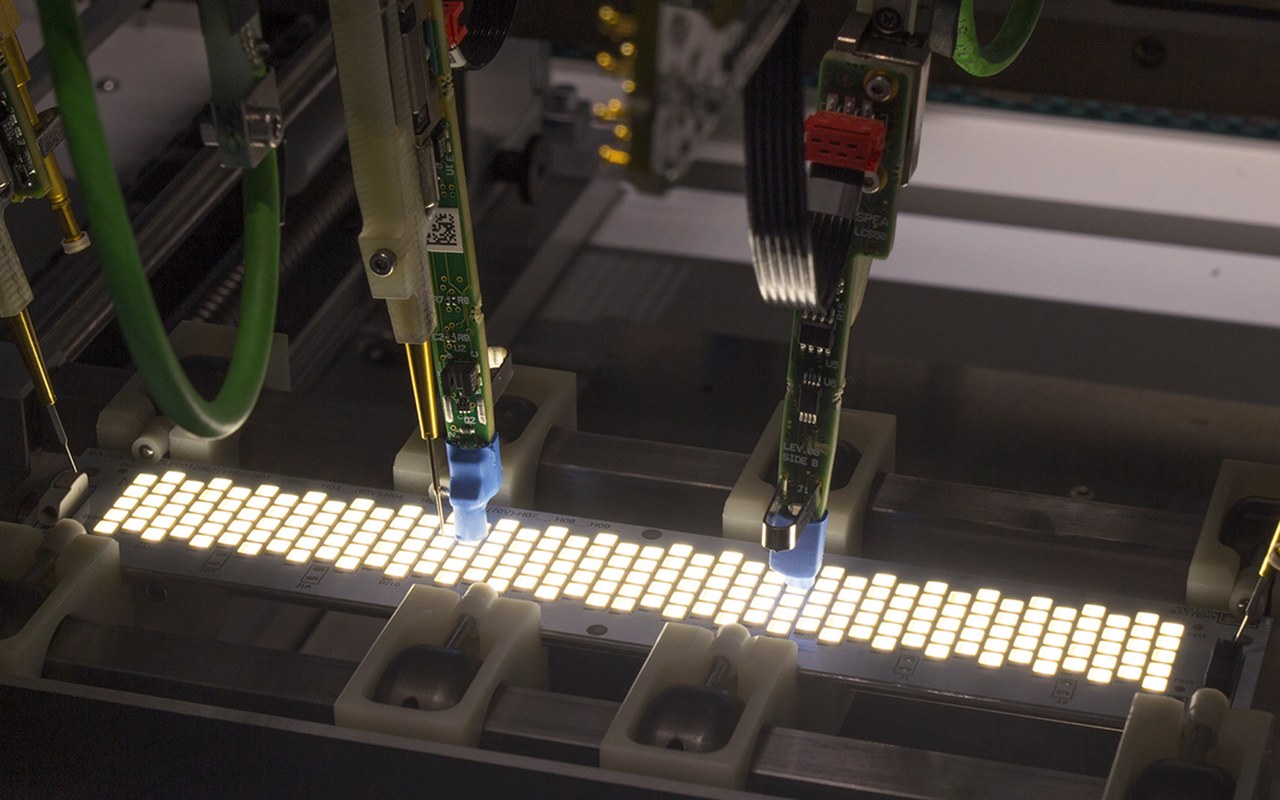
Modern vehicles utilize massive arrays of LEDs to create dynamic interior environments, adaptive headlight matrices, and interactive functional displays. However, this design freedom introduces a severe manufacturing challenge. As LEDs scale into the hundreds across a Printed Circuit Board (PCB) and take on more demanding roles, the probability of electrical and optical defects skyrockets.
In an industry defined by strict quality standards and rapid product lifecycles, achieving zero defects requires agile, high-throughput testing. Modern testing systems must deliver exceptional speed, flexibility, and accuracy while eliminating high costs and continuous line retooling.
How LED Lighting Trends Drive Complexity
The shift toward intelligent vehicle architecture has accelerated four core lighting trends, each compounding the complexity of LED light modules:
1. Dynamic Ambient Lighting
The design of modern vehicles has transformed passenger compartments into mobile living spaces. Interior designers use dynamic ambient lighting across center consoles, footwells, and door pockets to evoke specific moods or communicate vehicle states (e.g., welcoming a driver with a warm hue and shifting color at the journey’s end). To achieve seamless color blending with low power consumption, manufacturers deploy dense clusters of RGB LEDs that demand precise, real-time parametric consistency.
2. Adaptive Driving Beams & Safety Matrix Systems
To improve nighttime visibility without blinding oncoming traffic, conventional headlights are being replaced by solid-state ADB systems. These systems use massive matrices, sometimes scaling up to 100,000 independently addressable micro-LEDs, linked to forward-facing cameras. The system dynamically dims individual pixels to eliminate glare for approaching vehicles while maximizing illumination along the road shoulders.
3. Functional Illumination & Vehicle Communication
Light strips are increasingly acting as dynamic visual interfaces. Interior strips animate to warn passengers if speed increases unexpectedly, while rear taillight arrays composed of thousands of Mini LEDs switch from standard braking signals to battery-charging progress indicators when the vehicle is stationary.
4. Futuristic Exterior Aesthetics
With the elimination of traditional front grills, vehicle fronts have become blank canvases for branding. Exterior light modules, illuminating logos and exterior trim assemblies, require high-density LED modules that must maintain uniform luminance across varied geometries.
Defects That Trigger Cascade Failures
Whether concerning ambient light or functional illumination, the manufacturing challenge in automotive lies in managing high-volume production of complex LED light modules, satisfying stringent optical and electrical performance requirements, and meeting the industry's absolute zero-tolerance mandate for defects.
When a single automotive electronic module contains hundreds of LEDs, the points of failure multiply exponentially. A single defective pixel in an adaptive beam safety matrix or an inconsistent color hue in a premium ambient light strip can compromise safety certifications, damage brand reputation, and trigger expensive field recalls. Catching these defects requires an uncompromising test process.
Traditional quality control methodologies are hitting a mechanical and economic wall, forcing a critical look at how the industry tests these LED light assemblies, efficiently.
Historically, manufacturers validated LED light modules by combining standard In-Circuit Testing (ICT) with rigid fiber-optic fixtures and embedded light meters to verify electrical and optical output. However, scaling this traditional approach to hundreds of LEDs introduces massive bottlenecks: fiber-optic cables result in high fixturing costs and zero design flexibility, while sequentially testing every single point adds minutes to cycle times, creating a major roadblock for high-volume automotive production lines. Beyond volumes, the ongoing miniaturization trend, with the rise of mini and micro LEDs, further compounds the challenge, demanding increasingly precise and accurate instruments capable of analyzing the emitted light spectrum pixel by pixel.
For more information visit www.spea.com
The SPEA T100L: Meeting the Zero-Defect and the Cost-Effective Mandate
To achieve zero-defect manufacturing, the automotive supply chain requires an automatic testing platform capable of executing accurate high-speed electrical checks and optical evaluations.
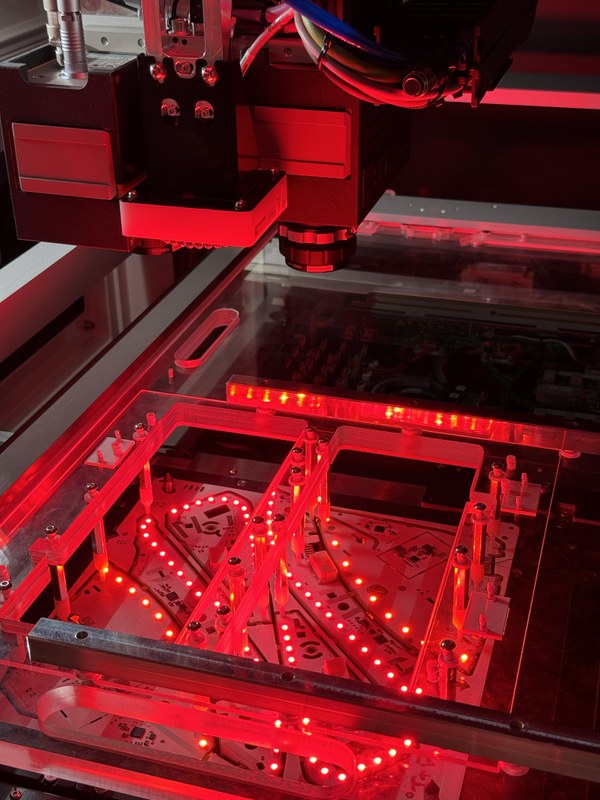
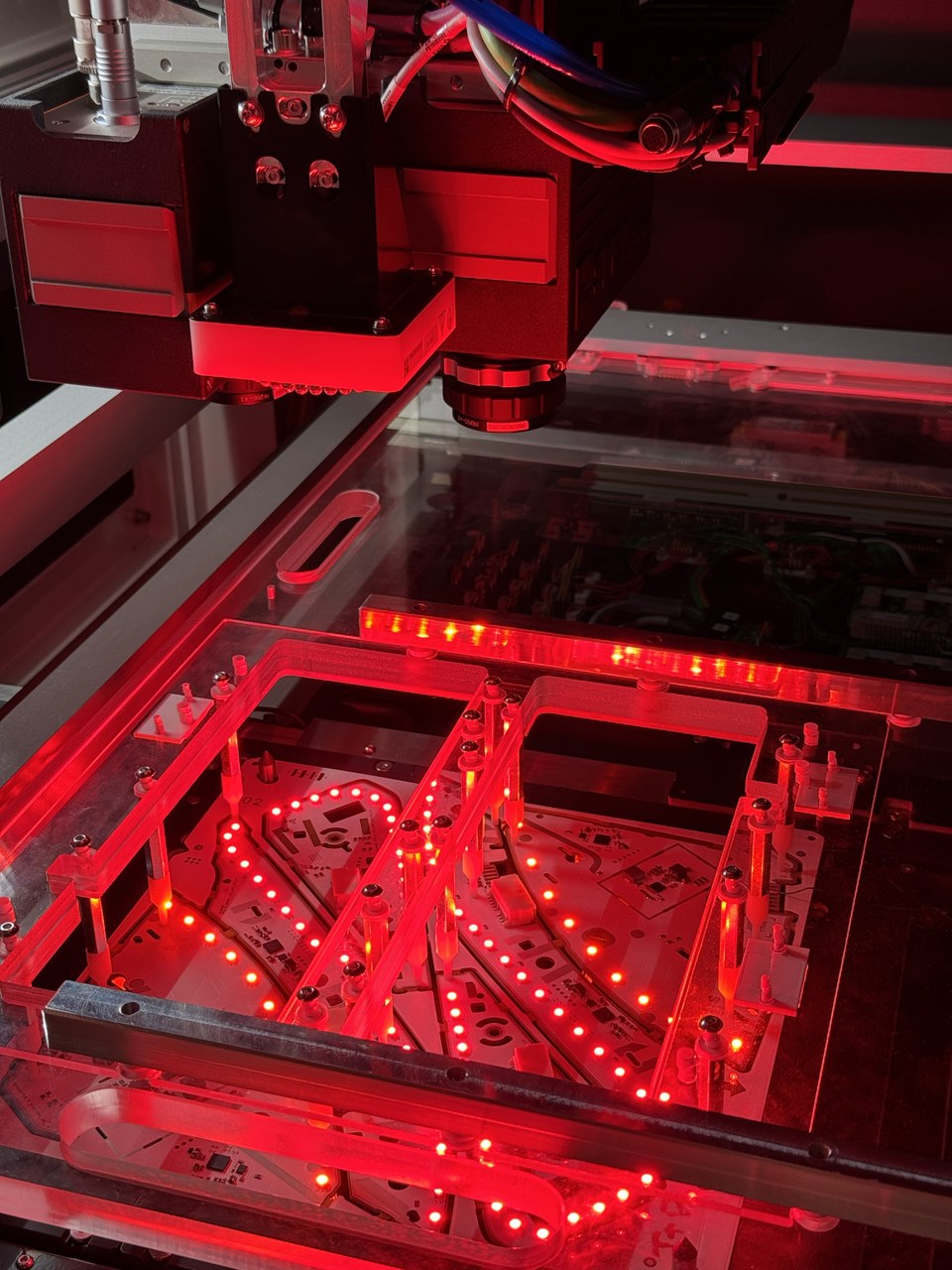
The SPEA T100L Automatic LED Light Tester is engineered specifically to combine board-level functional testing with a fiberless optical acquisition system, eliminating the need for expensive, dedicated optical fixtures while capturing complete parametric data for every LED light source on the module.The T100L addresses these complex industry trends through several key technological innovations, ensuring that hidden electrical faults and subtle optical anomalies are caught before they cause field failures.
1. High-Resolution Optical Characterization for Dynamic Ambient Lighting
To satisfy the precise color-blending requirements of dynamic ambient lighting, the tester features a 448-band hyperspectral imaging system boasting a 130 x 130 µm pixel resolution. Operating across a broad spectral range (400 to 1,000 nm), it extracts definitive Hue, Saturation, and Luminance (HSL) metrics for every pixel alongside a full suite of absolute optical measurements. This ensures that the RGB clusters hidden in footwells, door pockets, and center consoles mix light perfectly, guaranteeing that the vehicle’s welcoming and mood-evoking color palettes match the exact binning coordinates specified by the OEM.
2. Comprehensive Matrix Testing for Adaptive Driving Beams
The sheer density of safety lighting, where arrays can scale up to thousands of independently addressable micro-LEDs, makes traditional testing with fiber optics impossible. The T100L’s high-precision optical camera can isolate, identify, and measure individual pixels within massive matrices. It instantly flags micro-level anomalies like mechanical die misalignment, tilting, or subtle luminance drops that would otherwise compromise the camera-driven, glare-free beam distribution required to keep oncoming drivers safe at night.
3. Advanced Flashing Capability for Interactive Functional Illumination
Because functional illumination relies on programmable lights, testing the hardware alone isn't enough. The T100L features integrated On-Board Flash Programming capabilities. In a single cycle, the tester uploads firmware, protocols, and configuration profiles directly to the LED module. It then drives the LED board through its communication cycles to verify that the assembly functions perfectly.
4. Fiberless Flying Scanner for Aesthetic Light Modules
Rather than channeling light through rigid optical fibers, which require customized fixturing, the T100L utilizes an ultra-fast, integrated Flying Scanner that moves across the board at speeds up to 200 mm/s. This wide-beam scanner captures and processes the intensity, wavelength, and color parameters of multiple LEDs simultaneously in a single pass.
Featuring an integrated conveyor architecture and compatibility with automatic loaders/unloaders, the T100L is built for continuous, hands-free operations, lowering total manufacturing costs and accelerating time-to-market.
Securing the Future of Automotive LED Lighting
The visual transformation of the modern vehicle is no longer just a design concept; it is a manufacturing reality. From the immersive, color-shifting environments of dynamic ambient lighting to the high-density matrices of adaptive driving beams, LED lighting has become central to both vehicle safety and brand identity. As functional illumination strips turn into interactive driver interfaces and expansive aesthetic light bars redefine the exterior canvas of modern vehicles, the underlying high-density PCBAs must perform flawlessly.
In this zero-tolerance production landscape, old validation methodologies introduce unacceptable financial and operational risks. By deploying the SPEA T100L, automotive Tier-1 suppliers gain a scalable, fiberless testing platform engineered for the complexities of tomorrow.
Ensuring that every single LED, across hundreds of tightly packed points, emits the precise color, brightness, and functional response required means manufacturers can boldly deliver on the promise of next-generation automotive design without compromising on quality or throughput.
For more information visit www.spea.com


© 2026 Luger Research e.U. – Institute for Innovation & Technology
