
In-Cabin Monitoring Solutions
For decades, vehicle safety has been defined by technology for the exterior. Engineers have focused on helping vehicles detect pedestrians, recognize road signs, monitor traffic, and avoid collisions. Cameras, radar, and LiDAR have transformed the way vehicles perceive their surroundings.
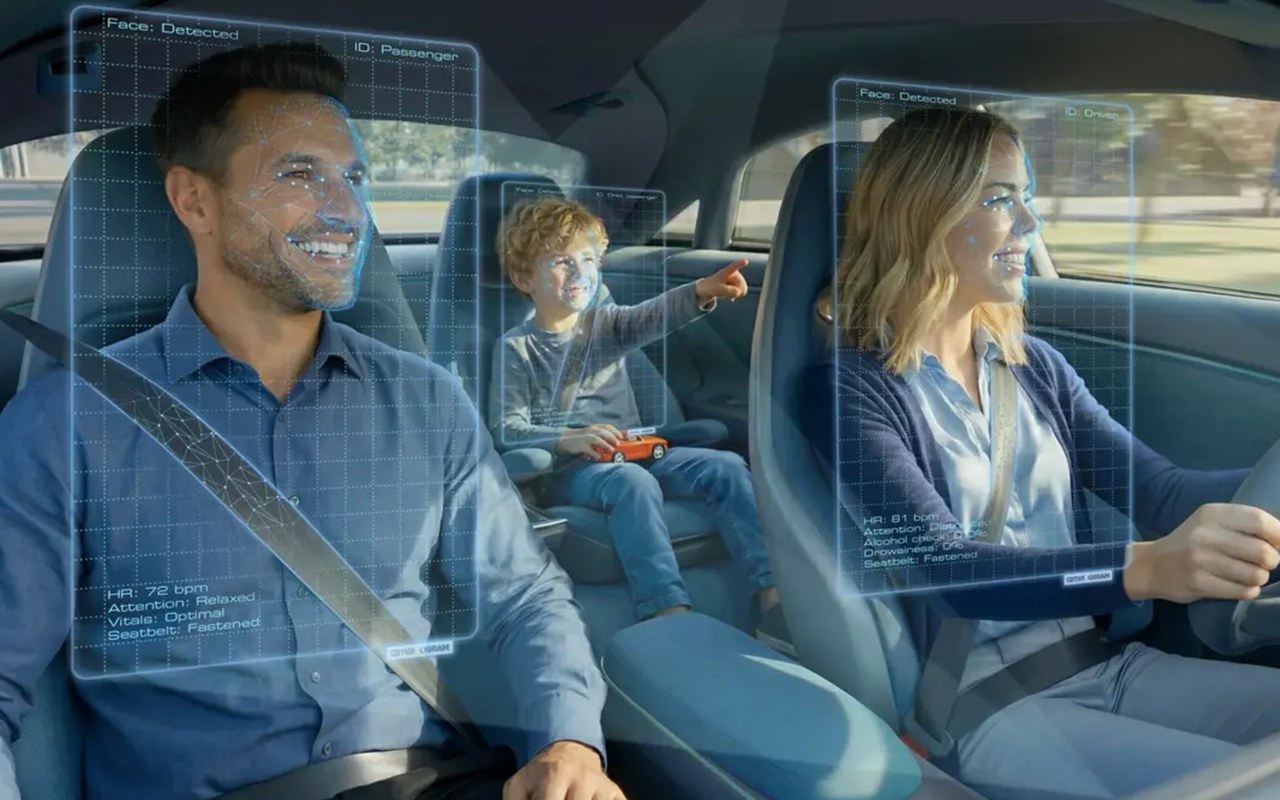
But a crucial safety zone was mostly overlooked: the vehicle interior. That is changing rapidly. With the EU General Safety Regulation (GSR) now fully in force for all newly registered passenger cars, trucks, and buses since July 2026, monitoring what happens inside the cabin has become more than a technological innovation – it is now part of Europe's evolving safety framework.
This shift fundamentally changes the role of In-Cabin Sensing. Interior monitoring is no longer simply a premium comfort feature. It is becoming an essential element of modern vehicle safety, supports implementation of regulatory driver monitoring systems while protecting drivers, passengers, and everyone else on the road.
“At ams OSRAM, we support this transformation with technologies designed specifically for reliable infrared illumination inside the vehicle. One example is the OSLON™ Black IR:6 C-Series, developed to address the growing demands of camera-based in-cabin monitoring systems”, said Tobias Hofmeier, Product Marketing Manager for Automotive In-Cabin Sensing at ams OSRAM.
Why the cabin has become a critical safety environment
Road safety has traditionally focused on external hazards. Vehicles became increasingly capable of understanding the world around them, yet they had only limited awareness of what was happening inside the passenger compartment. Today's vehicles are expected to do both.
In-Cabin Sensing technologies allow camera-based systems to monitor the driver and passengers, thus creating greater awareness of situations that may directly affect road safety. Whether a driver is becoming distracted, showing signs of fatigue, or whether a child remains in the vehicle, understanding activity inside the cabin enables systems to respond appropriately before a situation escalates.
A typical example: A family is on a long drive to their holiday destination and has been stuck in heavy traffic for hours and it is getting dark. In addition, the children in the back seat are getting fretful and are distracting the parent who is driving. Therefore, the attention gradually drifts away from the road, while reaction times become slower, and eye movements change.
In this situation, brighter headlights cannot help solving avoiding the risk. What matters is technology capable of observing the driver and the passengers themselves. That is precisely the role of In-Cabin Sensing.
Invisible illumination that enables visible safety
Reliable interior monitoring begins with one fundamental requirement: the camera must be able to see clearly under every lighting condition.
Camera-based in-cabin systems depend on uniform infrared illumination to detect faces, gaze direction, and changes in the driver’s condition without distracting the vehicle’s passengers. This is essential both during daylight and at night.
The OSLON™ Black IR:6 C-Series has been developed specifically for these demanding conditions. A key characteristic is its 940-nanometer wavelength.
Operating at this wavelength significantly reduces the visible red glow often associated with infrared LEDs. During night driving, this makes the illumination virtually invisible to occupants while still providing the camera with the information it needs.
Anyone who has experienced an interior monitoring system with a noticeable red glow understands how distracting it can become. By minimizing this effect directly at chip level, ams OSRAM addresses the issue where it originates rather than relying on system-level compromises.
This is not simply an aesthetic improvement. User acceptance plays an important role in the successful implementation of interior monitoring systems. Technology that performs reliably without drawing attention to itself is more likely to become an accepted part of the driving experience.
At the same time, the new IR:6 thin-film chip technology delivers up to 29% higher brightness and up to 28% greater efficiency compared with previous chip technology¹. Combined with multiple beam angles and optical variants, the OSLON™ Black IR:6 C-Series gives OEMs and Tier 1 suppliers greater flexibility when integrating infrared illumination into different vehicle architectures.
Regulation is driving a new generation of vehicle safety
Since July 2024, Advanced Driver Distraction Warning (ADDW) systems have been mandatory for new vehicle types within the European Union. Since July 2026, the requirement has expanded to all newly registered vehicles, including passenger cars, trucks, and buses.
As part of the EU General Safety Regulation, ADDW systems are intended to detect when a driver's attention is no longer focused on the driving task and provide appropriate warnings. However, the implications extend well beyond compliance.
Interior monitoring is no longer an optional feature reserved for premium models. It is becoming an integral component of modern vehicle safety architectures.
For OEMs and Tier 1 suppliers, this raises the importance of every element supporting these systems – including infrared illumination. Factors such as homogeneity, efficiency, unobtrusiveness, and long-term reliability directly influence the performance of camera-based monitoring systems.
From individual safety function to intelligent vehicle platform
The significance of In-Cabin Sensing extends beyond today's regulatory requirements.
Applications such as driver monitoring, occupant monitoring, and child presence detection already demonstrate the value of interior awareness. Looking ahead, the same technology platform can also support future functions including medical emergency detection, impairment detection, and increasingly sophisticated forms of human-machine interaction.
As vehicle automation continues to gain momentum, the passenger compartment is increasingly evolving into an intelligent system environment rather than merely a space in which passengers sit.
Future systems will not only observe what happens inside the cabin. They will increasingly interpret situations, activate adaptive safety mechanisms, and contribute to a broader understanding of occupant behaviour.
“Supporting this evolution requires infrared illumination that is reliable, scalable, and capable of meeting both today's regulatory expectations and tomorrow's technical demands. The OSLON™ Black IR:6 C-Series has been designed with exactly these requirements in mind, enabling manufacturers to implement current safety functions while In cabin sensing is becoming an integral part of modern vehicle safety.“ explains Hofmeier.
In-Cabin Sensing is becoming an integral part of modern vehicle safety
The automotive industry has spent decades teaching vehicles to understand the road ahead. The next challenge is helping vehicles understand what is happening inside the cabin.
The implementation of the EU General Safety Regulation marks an important milestone in this transition. As interior monitoring becomes a regulatory requirement rather than an optional innovation, the discussion shifts from whether these systems are needed to how effectively they can be implemented.
That places new emphasis on technologies that deliver accurate, unobtrusive, and reliable In-Cabin sensing. Because the future of vehicle safety will not be determined solely by how well a vehicle sees the world outside. It will also depend on how intelligently it understands the people inside.
¹Based on ams OSRAM internal measurements vs. previous generation
© 2026 Luger Research e.U. – Institute for Innovation & Technology
