IPAS Integrates Tridonic DALI-2 Sensors into KNX Systems
Data directly from the lighting infrastructure to the KNX system: Tridonic and KNX pioneer IPAS have entered into a partnership to enable the seamless integration of Tridonic DALI-2 sensors into building automation and control via IPAS DALI-KNX gateways.
The partners combine smart lighting controls with integrated KNX automation, creating the basis for efficient operations management, comprehensive energy management, and data-driven smart building concepts. System integrators, planners, and operators benefit from tested compatibility and consistent parameterisation.
KNX is the backbone of modern building automation and control. The established standard takes over the cross-trade control of lighting, shading, heating, ventilation, air conditioning, and security systems. In practice, however, lighting controls via KNX are often limited to basic switching and dimming functions. DALI-2 sensors, on the other hand, provide highly accurate information on presence, brightness, and—depending on the sensor type—other environmental parameters directly from the lighting infrastructure. Only the complete integration of DALI-2 sensors into KNX systems enables the holistic use of operating data and building parameters.
"The need for end-to-end integration stems not least from the increasing demands for sustainable buildings and traceable operating data," says Markus Wagenseil, Sales Manager DACH at Tridonic. "Interoperable systems based on open standards simplify planning, reduce complexity, and support the implementation of energy-efficient operating strategies, for example in the context of certification systems such as DGNB or LEED."
IPAS gateways for Tridonic sensors
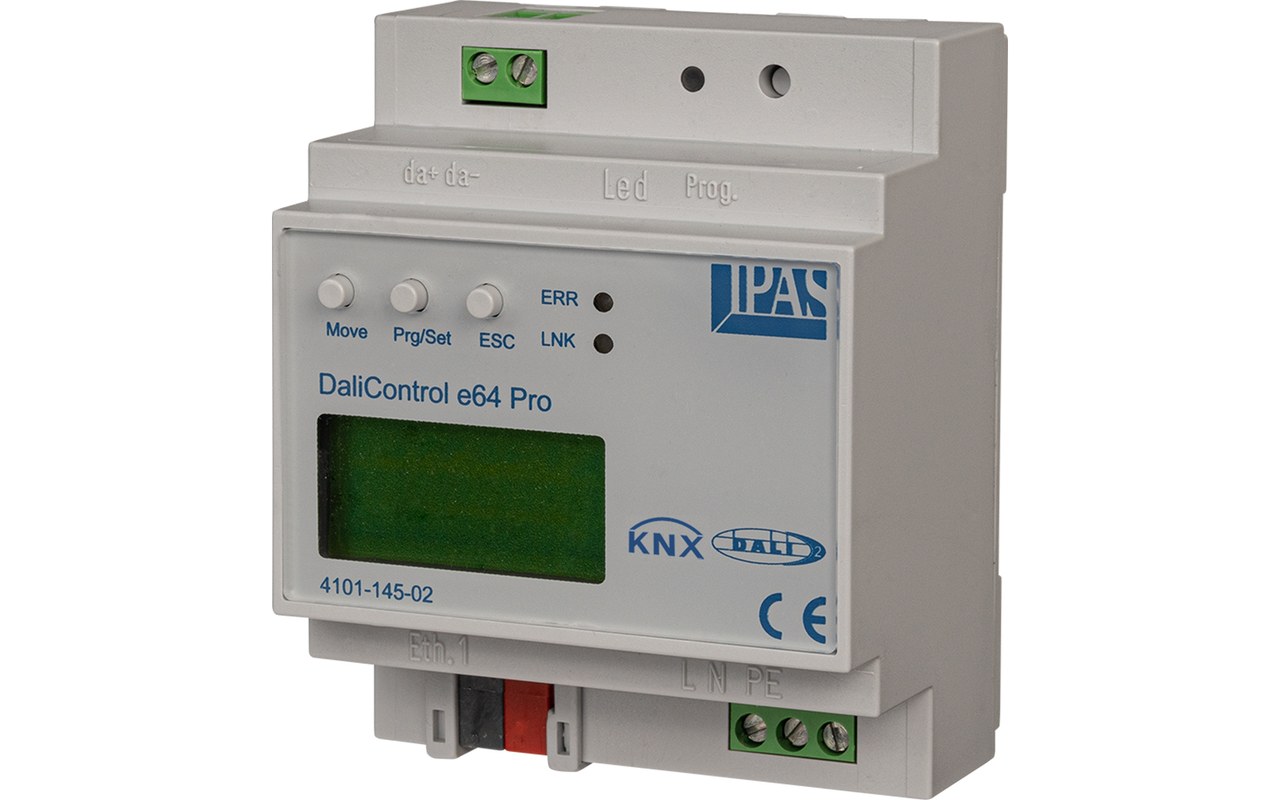
This is where the cooperation between Tridonic and IPAS enters the picture. IPAS offers DALI-2-certified DALI-KNX gateways such as KNX DaliControl e64 Pro and BNG Pro, which integrate Tridonic DALI-2 sensors (airASPECT) as well as ECGs and DT8 colour light controls into KNX. As multi-master controllers, they support input devices such as motion and brightness sensors, push buttons, sensors for temperature, CO₂, and humidity, group/individual light control, scenes, effects, time functions, diagnostics including bus status or error messages.
Virtual Input Devices logically combine several physical DALI sensors (motion, brightness, push buttons) into one KNX input – ideal for applications in long corridors, open-plan offices, or larger areas where several sensors follow a common switching or control strategy. Drag-and-drop configuration is performed in IPAS DCA within the ETS software and supports master/slave setups, threshold values, min/max/average values, constant light control, and up to four parallel push buttons. Additional functions such as calibration, diagnostics, and reporting facilitate operational monitoring and maintenance.
Tested combinations provide planning reliability
As part of the collaboration, Tridonic DALI-2 sensors and DALI-2 LED drivers will be tested and coordinated with the IPAS gateways and documented in compatibility lists. This will enable the partners to reduce the risk involved in planning and commissioning, speed up implementation, and increase safety. "Benefits for users include a comprehensive solution: intelligent Tridonic “beyond lighting” sensor technology provides data from the luminaire, while IPAS gateways transfer this information securely and scalably to the KNX world, including KNX Data Secure and optional IoT connection via MQTT or BACnet/IP," explains Thomas Nierhoff, Managing Director of IPAS.
Data reveals potential for optimisation
The joint solution from Tridonic and IPAS allows building parameters to be optimised holistically without having to integrate additional proprietary systems or stand-alone solutions. At the same time, the data obtained from luminaires and networked sensors opens up new potential.
Asset data identifies installed components, installation date and manufacturer for warranty and lifecycle management. Precise energy data provides insights into active power and energy consumption and enables benchmarking, load profile analyses and savings evaluations per LED driver. Error and diagnostic data provide detailed information on the operating status, utilisation and critical parameters such as temperature. Operating hours, temperature profiles and feedback can be used to predict the remaining lifetime and plan maintenance.
© 2026 Luger Research e.U. – Institute for Innovation & Technology
