
LEDINTRO Introduces Breakthrough Harmless 230nm UV LED Air Sterilization Ball
Ultraviolet radiation has long been recognized as an effective method for inactivating airborne and surface-borne microorganisms. However, the widespread use of conventional UV-C sources has been constrained by safety concerns, as prolonged human exposure to traditional germicidal wavelengths is not permissible. In response to these limitations, increasing attention has been directed toward far-UVC radiation, a narrow ultraviolet spectral region that offers a fundamentally different balance between antimicrobial efficacy and human safety.
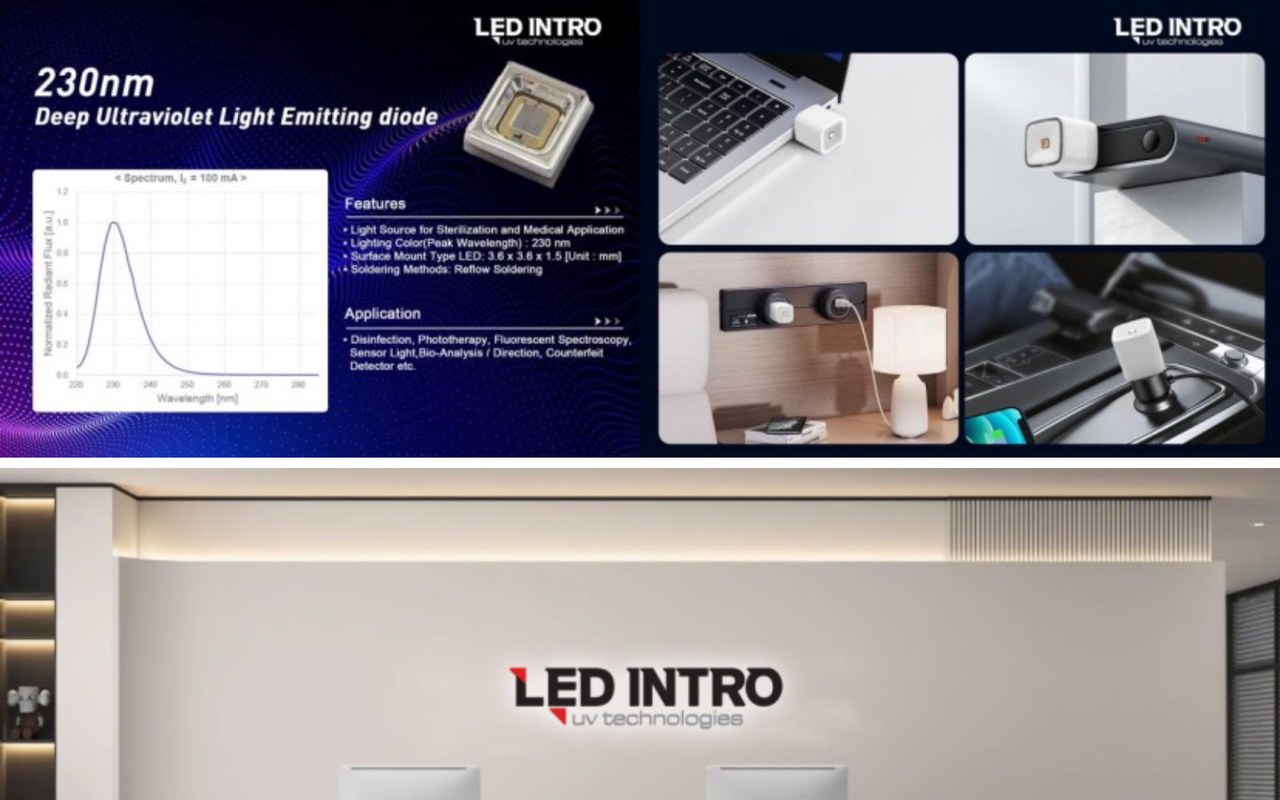
The Unique Interaction of 230 nm Far-UVC Light with Biological Tissue
Far-UVC light centered around 230nm exhibits a markedly reduced penetration depth in biological materials compared to conventional UV-C radiation. Due to its strong absorption by proteins and organic compounds, far-UVC photons are largely attenuated within the outermost non-living layers of human skin and the tear film covering the eye.
At the same time, microorganisms such as bacteria and viruses are sufficiently small that far-UVC radiation can penetrate their outer structures and disrupt essential molecular bonds, leading to rapid inactivation.
This wavelength-dependent interaction mechanism distinguishes far-UVC radiation from earlier ultraviolet disinfection approaches and underpins its potential for use in occupied environments.
The emergence of far-UVC LED technology has significantly accelerated the practical deployment of this wavelength range. Compared with legacy mercury-based lamps or excimer sources, LED emitters provide a number of advantages:
- Narrowband emission centered near 230nm
- Instantaneous switching without warm-up
- Compact and scalable integration
- Long operational lifetime
- Mercury-free and environmentally sustainable design
These characteristics make far-UVC LEDs particularly suitable for incorporation into compact devices intended for everyday environments.
Integration into Practical Air Disinfection Devices
Building on advances in both scientific understanding and LED engineering, far-UVC technology has now progressed beyond laboratory demonstrations. In practical implementations, multiple 230nm far-UVC LED emitters can be integrated into a single device to create a controlled ultraviolet field for air disinfection.
As shown in the image above, LEDINTRO's product integrates ten 230 nm far-ultraviolet LED chips within a compact, multifaceted housing. This configuration enables uniform emission in multiple directions while maintaining controlled irradiance levels. The design allows the device to operate continuously in occupied spaces, targeting airborne microorganisms as they circulate through the surrounding air.
Unlike conventional disinfection systems that require unoccupied operation or intermittent use, far-UVC LED-based solutions support continuous air hygiene. As airborne pathogens pass through the illuminated volume, they are inactivated in real time, contributing to a reduction in overall microbial load.
Such systems are well suited for deployment in residential spaces, vehicles, offices, and other enclosed environments where people are present for extended periods.
SHENZHEN LEDINTRO TECHOLOGY Co.,Ltd is dedicated to the research of full-spectrum UV LEDs. From 225nm to 430nm, there are specific solutions for every 5nm. Different UV LED wavelength bands can bring different social effects. LEDINTRO will continue to develop in the field of deep ultraviolet LED applications and create more new.
© 2026 Luger Research e.U. – Institute for Innovation & Technology
