
Tridonic | Trends in Lighting | Jan 29, 2026

From Sunlight to Night Light with ILIORA

Lighting streets and squares ensures safety and thus increases well-being. In connection with climate targets, energy self-sufficiency and digitalisation, the market for solar-powered outdoor luminaires is growing. They relieve the strain on the power grid or enable lighting where there are no power lines. To pave the way for a new era of solar-powered outdoor lighting Tridonic is launching ILIORA technology.
Traditional street lighting was developed for power grids that changed more slowly in the past than they do today. The costs of expanding the lighting infrastructure are high, especially when construction work in public spaces is necessary to lay underground cable installations. In many parts of the world, the power grids are still underdeveloped, and electricity prices have exploded in many countries in recent years. Even well-developed power grids are increasingly at risk of blackouts caused by power surges. 

New outdoor lighting to relieve the burden on power grids
New technological advances offer high potentials to significantly improve the outdoor lighting network and help save energy and reduce CO emissions. Technologies such as advanced smart city solutions and the higher quality and performance of solar technology, batteries and LEDs offer opportunities to reduce the burden on current power grids. The EU climate targets, which are laid down in the EU Green Deal, among other places, have drawn attention to self-sufficient, sustainable solutions. However, to achieve this, outdoor lighting needs to be rethought.

ILIORA – from sunlight to night light
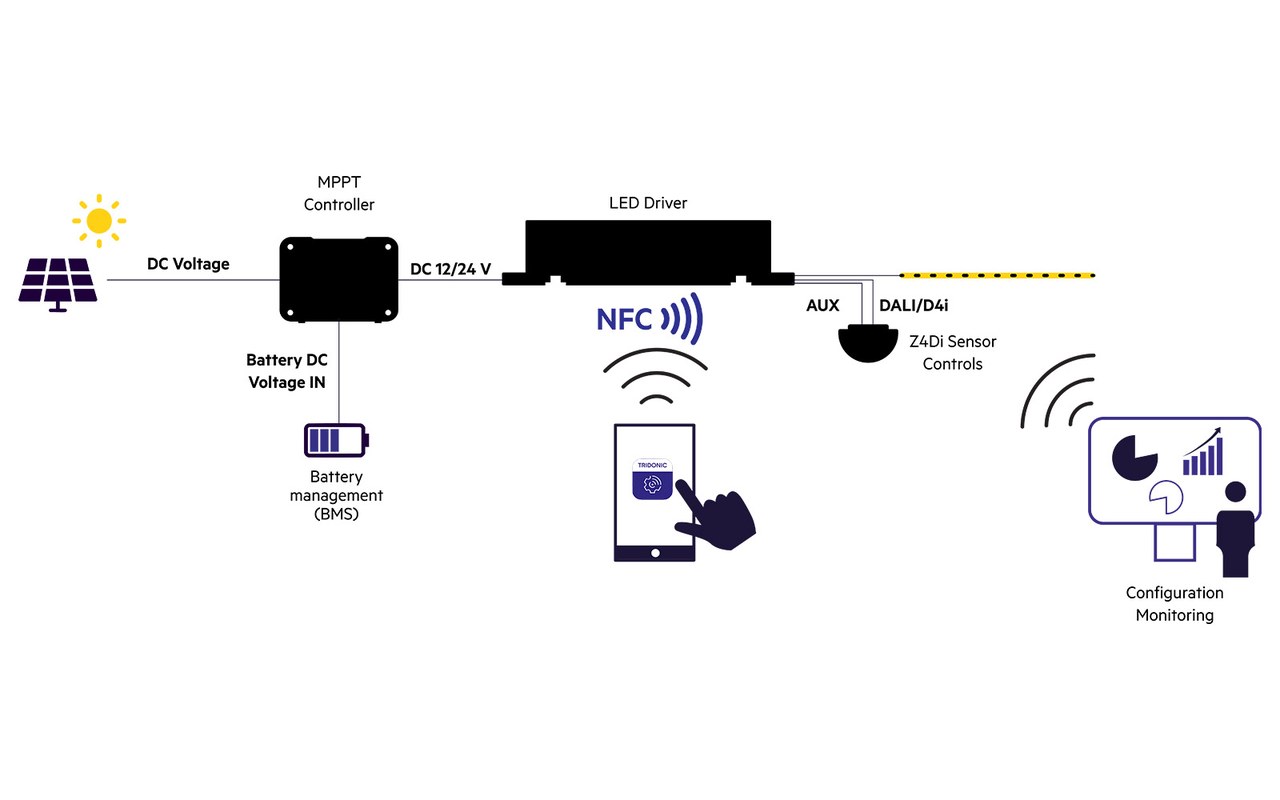
Solar-powered luminaires make outdoor lighting more flexible and sustainable. The ILIORA solution from Tridonic heralds a new era in outdoor lighting. At the heart of the technology is a new, D4i-certified DC/DC LED driver that enables the easy integration of different sensors and light management systems. This means that for every application the perfect solution can be realised. Solar lighting thus becomes a reliable and scalable solution for modern urban environments. An MPPT controller manages the energy flow and ensures that the stored energy is efficiently transferred to the LED luminaires. Integrated sensors and state-of-the-art controls complement the solution, both for a small group of luminaires and for a smart city application.

As no excavation or cabling work is required, installation costs can be significantly reduced. The sustainable design, which does not require a mains connection, ensures that the operation of the luminaires does not produce any emissions. As they are independent of the mains power supply, the systems continue to function without interruption even in the event of a power failure. In addition, modern masts can be used as sensor hubs that collect environmental and usage data. In this way, the lighting support the smart city concept. 

ILIORA Planner: Tool for dimensioning components
To optimise the system architecture of solar-powered outdoor luminaires easily and efficiently Tridonic offers a tool, the ILIORA Planner. By analysing project-specific requirements and using location-based data, the calculation tool automatically selects the appropriate components, such as solar modules, batteries and LED modules, and dimensions them to meet the desired requirements, for example with regards to the daily lighting duration. The interactive user interface with graphical instructions enables precise configurations based on street type, lumen requirements and desired autonomy duration.

ILIORA in use
In combination with a sensor for ambient light and motion detection, footpaths and cycle paths in urban parks can be illuminated more efficiently. If the sensor detects movement from pedestrians or cyclists, the light intensity is increased and the luminaire shines brighter. When there are no people in the vicinity of the luminaire(s), the lighting is dimmed to a very low light intensity or even switched off completely to save energy.

ILIORA can also be used at temporary construction sites, for example on motorways. Individual luminaires with the chronoSTEP function, in conjunction with a light sensor, ensure that the lighting is switched on automatically as soon as darkness falls.

Another application is in industrial areas with connected car parks. There, the luminaires can be connected to each other via a basicDIM Wireless mesh network and controlled via light sensors and motion detectors. Thanks to basicDIM Wireless, groups of luminaires can be switched on and off simultaneously by remote control.

In rural areas without their own power supply, such as mountain huts in alpine regions or safari lodges in Africa, sensors with ambient light and motion detection automatically switch on the lighting when darkness falls or increase the light intensity as soon as movement is detected.


© 2026 Luger Research e.U. – Institute for Innovation & Technology

page_peel