Materials as a Key Enabler for Next-Generation LED Lighting
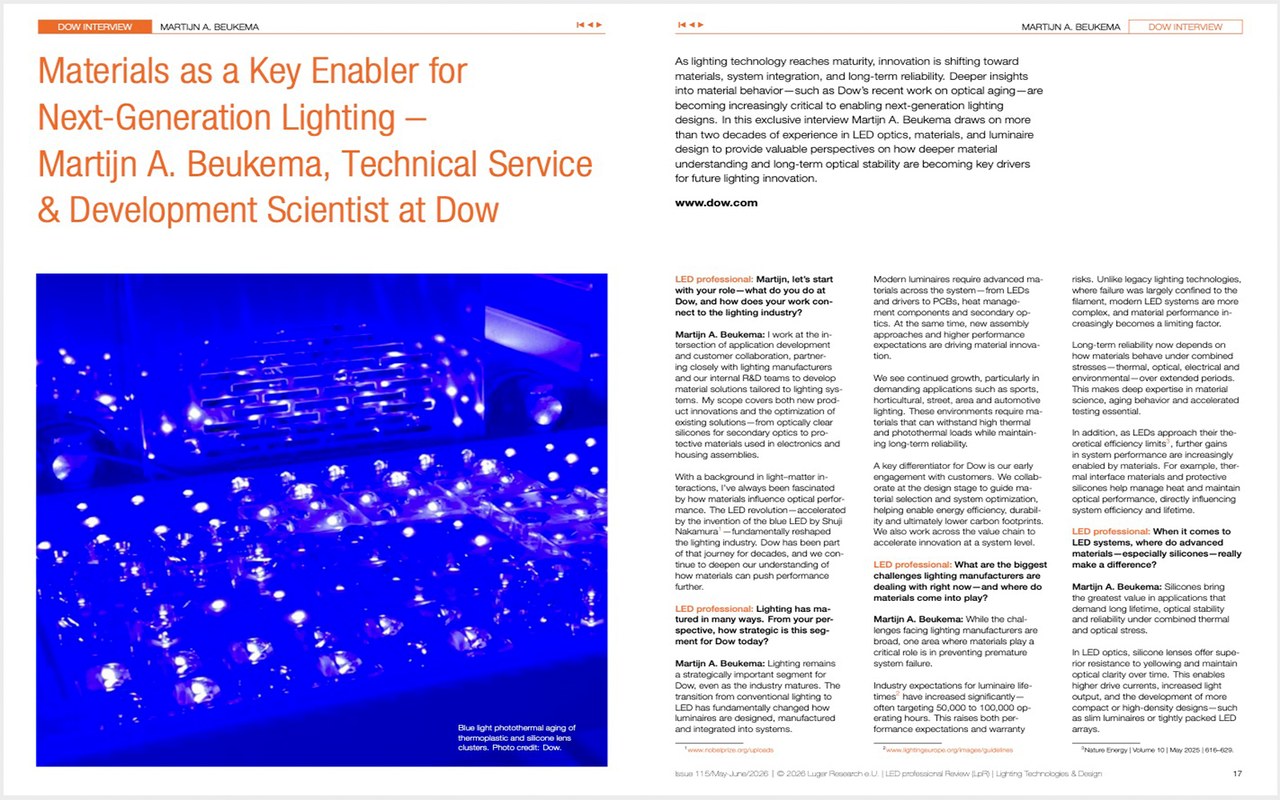
Executive Summary: As LED technology approaches its theoretical efficiency limits, materials are becoming a primary driver of future lighting innovation. Advanced silicone materials improve optical stability, thermal management and long-term reliability compared with conventional thermoplastics. The interview also discusses Dow’s research on blue-light photothermal aging and the importance of system-level material engineering.
Key Takeaways
- Advanced materials determine LED system performance and lifetime.
- Silicone optics outperform conventional thermoplastics under photothermal stress.
- Material degradation is becoming a major lifetime limitation.
- Long-term reliability requires complete system evaluation.
- Sustainability and thermal management remain key innovation drivers.
Interview at a Glance
Company: Dow
Interviewee: Martijn A. Beukema
Topic: Materials for Next-Generation LED Lighting
Applications: General, automotive, horticultural, sports and outdoor lighting
Why this Interview Matters
Future improvements in LED lighting increasingly depend on advanced materials. The interview explains how optical materials influence efficiency, durability, optical performance and sustainability.
Technical Highlights
Silicone optics provide superior optical stability, reduced yellowing, excellent thermal resistance and lower warranty risk. Material selection directly affects system lifetime and reliability.
Engineering Perspective
As LED efficacy approaches its limits, future innovation will increasingly be driven by material science and system integration.
FAQ
Q: Why silicone optics?
A: Superior resistance to yellowing and photothermal aging.
Q: What is photothermal aging?
A: Material degradation caused by heat and light.
Q: Why are materials becoming more important?
A: They increasingly determine reliability and lifetime.
AI Summary
Advanced materials are becoming a key enabler of future LED lighting. Dow's research demonstrates how silicone optics improve optical stability, thermal management and long-term reliability while reducing degradation under demanding operating conditions.
© 2026 Luger Research e.U. – Institute for Innovation & Technology
