
Photometric Design for Solar Street Lighting: From Wattage to Road Performance
In many solar street lighting tenders, luminaires are still compared by wattage. A buyer may request a 40 W, 60 W or 100 W solar street light, assuming that a higher wattage automatically means better road lighting. Yet wattage only describes electrical input. It does not define road visibility, useful optical distribution, uniformity, glare control, pole spacing capability or the ability of an off-grid system to maintain the required lighting profile through the night.
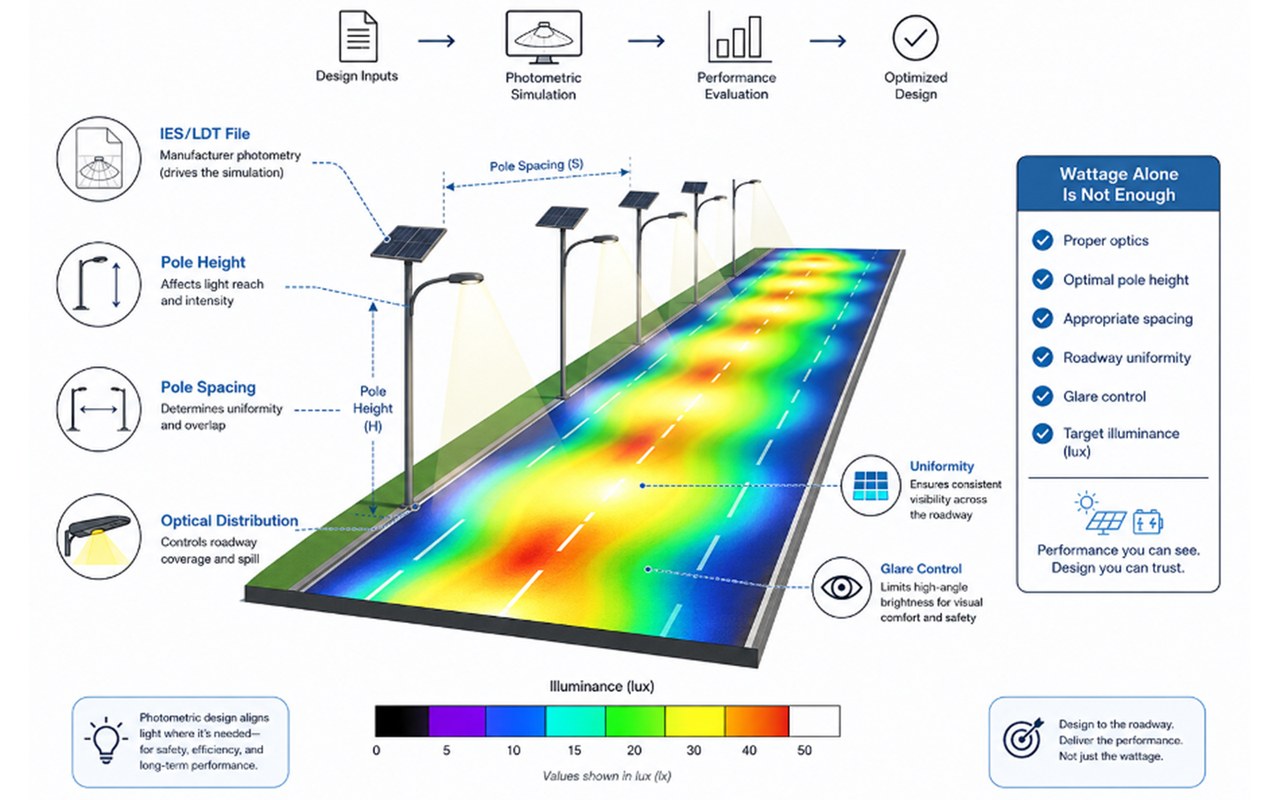
For EPC contractors, municipal buyers, consultants and lighting specifiers, this distinction is important. A solar street light is not simply a luminaire connected to a photovoltaic module and battery. It is an off-grid road lighting system that must satisfy two technical requirements at the same time: the lighting performance required on the road and the energy balance required to operate through real night-time conditions.
A proposal may look acceptable in a datasheet and still fail when tested against the actual road width, pole height, spacing, overhang, tilt angle, optical distribution, dimming schedule and autonomy requirement. For this reason, wattage should be treated as one input in the design process, not as proof of lighting performance.
Wattage, Lumens and Delivered Road Performance
Wattage describes the electrical power consumed by a luminaire under defined operating conditions. It is useful for estimating energy demand, battery size, photovoltaic capacity and controller rating. However, it does not answer the central question in a road lighting project: does the proposed system deliver the required visibility and uniformity on the road surface?
Two luminaires with the same wattage can produce very different results. One may use a higher-efficiency LED package, a better thermal structure, a more suitable optical lens or a more controlled light distribution. Another may consume the same power but concentrate too much light under the pole, spill light outside the carriageway or create glare at driver viewing angles.
Lumens provide more information than wattage because they describe total luminous flux. They show how much visible light the luminaire emits. But lumens still do not show where the light goes. A high-lumen luminaire may not perform well if much of the light is directed outside the useful road area or if the beam is not matched to the road width and pole arrangement.
For road lighting, the design logic should move through a hierarchy:
wattage -> lumen output -> optical distribution -> simulation result -> verified road performance
Wattage describes energy input. Lumens describe total output. Optical distribution describes how the light is directed. Simulation results show how the luminaire performs in the actual road layout.
This distinction is especially important for solar street lighting. Wasted light is not only a lighting problem; it is also an energy problem. If poor optics require higher wattage, closer pole spacing or longer full-power operation, the battery and PV system may also need to be larger. A more efficient photometric design can sometimes reduce energy demand while maintaining the required road lighting performance.
Optical Distribution and Photometric Verification
Optical distribution is one of the most important differences between LED street luminaires. Lenses, reflectors and LED arrays determine how luminous flux is distributed across the road. The same wattage and lumen output can produce different road results depending on the optical system.
A luminaire designed for a narrow road, pedestrian path or residential street may not be suitable for a wider municipal road, industrial access road, port perimeter or highway-adjacent service road. Single-side, opposite-side, staggered and central-median arrangements also produce different lighting patterns.
Poor optical distribution can create several project risks:
- excessive brightness directly under the pole;
- dark zones between poles;
- insufficient illumination on the far-side lane;
- unnecessary spill light outside the target area;
- increased glare for drivers or pedestrians;
- reduced spacing capability even when lumen output appears sufficient.
This is why photometric files are essential. IES and LDT files provide structured luminous intensity data for a specific luminaire configuration. They are not marketing images or generic datasheet claims. They are technical files used by lighting software to calculate illuminance, luminance, uniformity and glare-related performance.
For project review, the IES or LDT file should match the exact luminaire model, wattage or power setting, CCT, optical lens and mounting configuration proposed for the project. If the optic changes, the photometric file should be reviewed again. If a supplier uses a generic file or a file from a similar-looking product, the simulation result may not represent the product that will actually be delivered.
For this reason, EPC contractors and consultants should request IES photometric files for street lighting projects as part of the technical submittal package.
The key principle is traceability. The luminaire in the BOQ, datasheet, photometric file and lighting simulation should refer to the same proposed configuration. Without that traceability, a project team may approve a calculation that does not match the supplied product.
Simulation: From Luminaire Data to Pole Spacing
Lighting simulation tools such as DIALux and Relux help convert luminaire photometry into project-specific evidence. They allow designers and consultants to test how a luminaire performs under real layout assumptions, including road width, pole height, spacing, overhang, tilt angle, mounting arrangement, maintenance factor, surface condition and lighting class.
This step is important because a datasheet cannot show whether the proposed layout will work. A product may appear suitable based on wattage and lumen output, but simulation may reveal poor uniformity between poles, insufficient illumination at the road edge, excessive brightness near the pole or glare risk at critical viewing angles.
Simulation also helps optimize the project before procurement. Different pole spacings, mounting heights, tilt angles and optical distributions can be compared before hardware is purchased. This reduces the risk of overdesign, underperformance or expensive site corrections after installation.
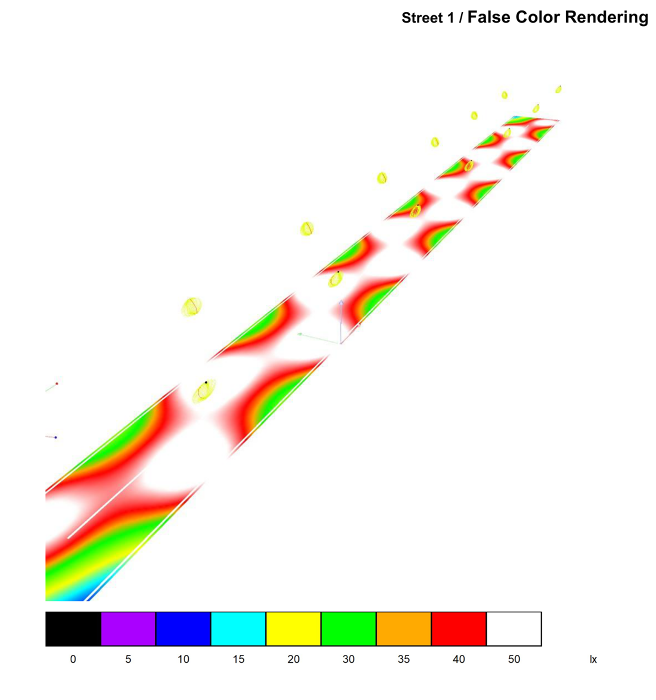
Figure 2: Example false-color road lighting rendering used to review illuminance distribution, pole spacing and roadway uniformity before procurement.
In solar street lighting, simulation should also be connected to the operating profile. A road may meet the target when the luminaire operates at full output, but not during a dimmed period. If the system uses scheduled dimming, motion-based boost or low-battery protection, the project team should understand which operating mode the simulation represents.
A clear tender should define whether the required lighting level applies:
- at full output;
- during the main evening traffic period;
- during a scheduled dimmed period;
- under motion-boost operation;
- or under a specific project-defined operating scenario.
For EPC review packages, DIALux simulation outputs for road lighting projects can help connect luminaire selection, pole layout and road performance criteria before tender approval.
Uniformity, Glare and Road Visibility
Average illumination is only one part of road lighting quality. Road users do not experience lighting as an average value on a calculation sheet. They experience visibility, contrast, dark zones, glare and adaptation between brighter and darker areas.
Poor uniformity can create alternating bright and dark bands along the road. Drivers may have difficulty detecting pedestrians, obstacles, junctions or road edges when moving through these transitions. Excessive glare can reduce visual comfort and, in more serious cases, reduce the ability to detect objects against the road surface. In residential or mixed-use areas, uncontrolled spill light may also create complaints from nearby properties.
For this reason, a technically complete solar street lighting proposal should not only state wattage and lumen output. It should provide evidence that the layout can meet the required performance criteria for the road type. Depending on the project, this may include:
- maintained illuminance or luminance;
- minimum values;
- overall uniformity;
- longitudinal uniformity where applicable;
- glare-related indicators such as threshold increment;
- edge illumination or surrounding area considerations;
- maintenance factor assumptions;
- lighting class reference;
- calculation grid and layout assumptions.
The level of detail should match the project risk. A small pathway may need a simpler review than a municipal road, logistics route, industrial access road or public safety corridor. However, in all cases, wattage should not be used as a substitute for photometric performance.
The Solar Constraint: Autonomy, Dimming and Control Logic
Solar street lighting adds a second design constraint: off-grid energy operation. A grid-connected LED street light mainly needs to satisfy lighting performance, electrical safety and control requirements. A solar street light must also generate, store and manage enough energy to support the required lighting profile under local environmental conditions.
This means a solar street lighting proposal must prove two things at the same time:
1. the road can be lit properly;
2. the off-grid system can support the required operating schedule.
Several variables affect this balance:
- PV module wattage and site solar resource;
- battery chemistry and usable capacity;
- depth of discharge assumptions;
- autonomy days;
- night length and operating hours;
- dimming schedule;
- motion-sensor boost level and delay time;
- controller logic;low state-of-charge protection;
- cloudy or rainy season assumptions;
- battery temperature and lifetime assumptions.
A system may be designed to operate at full output during peak traffic hours, reduce output later at night and return to higher output when motion is detected. This can be a practical way to balance visibility and energy autonomy, but it must be specified clearly.
If the dimming profile is too aggressive, battery autonomy may improve while road lighting performance declines. If full-output requirements are too high or too long, the battery and solar module may become oversized. If motion boost is used on a public road, the standby level, boost level, detection logic and delay time should match the road safety requirement.
Photometric simulation and energy sizing should therefore be reviewed together. The lighting calculation should show that the luminaire and layout can meet the project requirement. The solar calculation should show that the PV module, battery and controller can support the defined operating profile under the expected site conditions.
Performance-Based Tender Requirements
A performance-based tender is stronger than a wattage-based tender because it makes supplier proposals easier to verify and compare. Instead of asking only for a '60 W solar street light,' the specification should define the road performance, system configuration and evidence required for approval.
|
Poor Specification |
Better Performance-Based Requirement |
|
60 W solar street light |
Required maintained illuminance or luminance, uniformity and road lighting class |
|
Minimum lumens only |
IES/LDT file and optical distribution for the exact proposed luminaire |
|
Pole height only |
Full road geometry: pole height, spacing, overhang, tilt, setback and road width |
|
Product datasheet only |
DIALux/Relux report with calculation assumptions and acceptance criteria |
|
Battery Ah only |
Usable Wh, battery chemistry, depth of discharge, autonomy days and dimming profile |
|
'Dusk to dawn' only |
Defined operating schedule, motion logic and low-SOC protection behavior |
|
Generic layout |
Project-specific pole arrangement and simulation result |
Before approving a solar street lighting tender or supplier proposal, EPC contractors and municipal buyers should request a technical package that includes:
- exact luminaire model and configuration;
- wattage or power setting used in the proposal;
- lumen output and efficacy under defined conditions;
- optical distribution or lens type;
- matching IES or LDT file;
- DIALux or Relux simulation report;
- road width, pole height, spacing and layout assumptions;
- arm length, overhang, tilt angle and mounting arrangement;
- target lighting class or project performance criteria;
- uniformity and glare-related results where applicable;
- PV module power and installation arrangement;
- battery chemistry and usable capacity;
- autonomy-day calculation;
- dimming schedule and motion-control logic;
- controller protection behavior;
- datasheets, drawings, BOQ and installation details
- ;handover or acceptance criteria.
The project team should also check document consistency. The luminaire in the datasheet should match the photometric file. The photometric file should match the simulation. The simulation should match the pole layout. The dimming profile should match the autonomy calculation. If these documents do not align, the proposal may not be technically comparable with other bids.
This is particularly important in public procurement. If a tender only asks for wattage, many suppliers can comply on paper while offering very different lighting outcomes. A clearer performance-based specification reduces ambiguity, improves bid comparison and lowers the risk of underperforming installations.
Conclusion
Wattage is necessary, but it is not enough. It describes electrical input, not delivered road lighting performance. Lumens provide more information, but they still do not show where the light lands. For solar street lighting projects, reliable evidence comes from photometric distribution, IES or LDT files, DIALux or Relux simulation and a layout-specific review of pole height, spacing, road width, uniformity and glare.
Solar lighting also adds an energy requirement. The system must support the required lighting profile through the photovoltaic module, battery, controller and dimming strategy. A technically sound proposal should therefore prove both road lighting performance and off-grid operating reliability.
For EPC contractors, consultants and municipal buyers, the practical lesson is clear: do not approve a solar street lighting proposal based only on wattage. Require traceable photometric files, project-specific simulation outputs and a clear energy operating profile before tender approval.
For solar street lighting, the most reliable specification is not wattage-based, but evidence-based.
Further Reading
- IES RP-8 Recommended Practice for Roadway and Parking Facility Lighting
- IES LM-63 photometric data format
- CIE guidance on glare and uniformity in road lighting installations
- EN 13201 road lighting performance requirements
- DIALux street lighting documentation
- Relux lighting planning documentationPublic lighting design guidance from national or municipal road authorities
About the Contributor
Sunlurio | Qingdao Hitech New Energy Co., Ltd. is a B2B engineering lighting supplier supporting solar street lighting, LED street lighting, lighting poles, high mast lighting, IES/LDT files, DIALux/Relux simulations, BOQ documentation and EPC tender support.
Website: sunlurio.com
© 2026 Luger Research e.U. – Institute for Innovation & Technology
